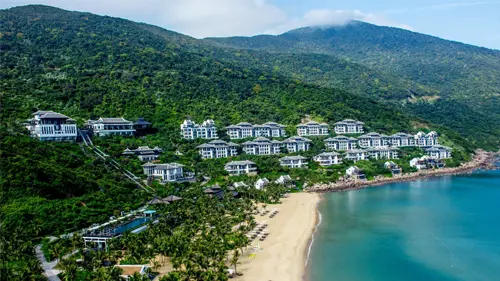
Perched on the eastern slopes of Son Tra Peninsula, overlooking the endless blue of the East Sea, Linh Ung Pagoda is home to one of Vietnam's most iconic Buddhist monuments: the 67‑metre Lady Buddha. Her white silhouette, visible from every beach in Da Nang, stands as a guardian of the city's fishermen. The pagoda complex, completed in 2010, blends traditional Vietnamese architecture with stunning coastal views. Banyan trees shade stone paths, and the air carries the scent of incense and sea salt. For travelers seeking spiritual serenity, architectural grandeur, and some of the best panoramic views in central Vietnam, this hillside sanctuary delivers on every promise.
The Lady Buddha: Guardian of the Sea
The centrepiece of Linh Ung Pagoda is the tallest Buddha statue in Vietnam. Standing at 67 metres (the equivalent of a 20‑storey building), the Lady Buddha – formally known as the Bodhisattva Avalokiteshvara – gazes southwest across the city of Da Nang. Her posture is one of gentle compassion. Her left hand forms a mudra of blessing, while her right hand holds a vial of nectar, symbolising the healing of suffering. She faces the sea not by accident but by design. Local legend says that before the pagoda was built, fishermen often reported strange lights and storms near this headland. The monks chose this location to calm the waters and protect the boats.
Inside the statue's base, a multi‑storey building houses an altar, exhibition halls, and a small museum. Visitors can climb a spiral staircase to viewing platforms located at the statue's waist and chest. From these heights, the panorama is breathtaking. To the north, the wild mountains of Son Tra Peninsula stretch toward Hai Van Pass. To the south, the entire curve of Da Nang Bay unfolds – the golden sands of My Khe Beach, the white towers of the city centre, and the distant Marble Mountains. On clear days, you can even see the Cham Islands on the horizon. The climb is not strenuous, but the stairs are narrow – be prepared to wait for others to pass. For photographers, the best time to photograph the Lady Buddha is late afternoon (4:00–5:00 PM), when the sun is behind her, creating a dramatic halo effect. A wide‑angle lens (16‑35mm) captures her full height from the courtyard below. A telephoto lens (70‑200mm) isolates her face against the sky – a stunning composition.
Around the statue's base, 18 bronze arhats (enlightened disciples) stand in various poses – some laughing, some meditating, some grimacing. Each one is over two metres tall. Children love running between them, and adults find themselves smiling at the whimsical expressions. Unlike the solemn Buddhas found in other temples, these arhats feel approachable, almost human. Look for the arhat holding a peach (longevity) and the one with an open book (wisdom). Touching their feet is considered a gesture of respect and is said to bring good luck. The entire statue complex is surrounded by a garden of frangipani and bougainvillea, with stone benches placed strategically for quiet reflection. Many visitors spend an hour simply walking the circular path around the Lady Buddha, reading the inscribed sutras on the stone panels, and watching the clouds move across the sea. There is no rush here. The pagoda asks only for your presence.
The Pagoda Complex: Architecture and Orchids
Below the Lady Buddha, a series of traditional structures spread across the terraced hillside. The main hall, or Bai Dinh Hall, follows classic Vietnamese Buddhist architecture: a curved red tile roof supported by massive ironwood pillars, with intricate carvings of dragons and lotus flowers adorning the eaves. Inside, three large bronze Buddhas sit on lotus platforms, representing the past, present, and future. The altar is crowded with offerings – fresh fruit, lotus flowers, and hundreds of small Buddha figurines donated by worshippers. Sunlight filters through the wooden lattice windows, illuminating motes of incense smoke. The effect is peaceful, even hypnotic.
To the east of the main hall, a long covered corridor connects to the bell tower, where a 1.5‑tonne bronze bell hangs. Visitors are welcome to ring the bell – gently – by pushing a suspended wooden log against its side. The sound is deep and resonant, rolling across the mountains and out to sea. In Buddhist tradition, ringing the bell awakens the mind from the sleep of ignorance. Even for non‑Buddhists, the act is satisfying, a small ritual that breaks the pace of sightseeing. Behind the main hall, a garden of bonsai trees and orchid displays (particularly beautiful in March and April) offers a quieter space. The orchids, grown by the resident monks, come in shades of white, purple, and deep pink. Some are named after Buddhist concepts – "Compassion", "Joy", "Letting Go".
The pagoda also features a large car park and a vegetarian restaurant, making it easy to spend half a day here. Unlike many religious sites, Linh Ung Pagoda is designed for visitors. The paths are wide and wheelchair accessible. The signage is bilingual (Vietnamese and English). The restrooms are modern and clean. Yet despite these conveniences, the pagoda has not lost its spiritual core. On full moon days (the 1st and 15th of the lunar month), local families arrive in large numbers, carrying incense and trays of fruit. The chanting from the main hall spills out into the gardens. It is a reminder that this place, for all its Instagram fame, remains a place of genuine devotion.
Monkeys, Views, and the Son Tra Peninsula Loop
Part of Linh Ung Pagoda's appeal lies not just in the pagoda itself, but in its setting on Son Tra Peninsula – a protected nature reserve famous for its red‑shanked douc langurs. These spectacular primates, with their grey bodies, black arms, white faces, and red legs, are found nowhere else on Earth. If you are lucky, you may spot them in the trees just outside the pagoda gates. The best time for langur sightings is early morning (7:00–8:00 AM) when they come down to feed. Keep a respectful distance – they are wild animals, and the mothers with babies are particularly protective. Use a telephoto lens rather than approaching too closely.
After exploring the pagoda, drive further up the peninsula. The coastal road, which continues north for another 12 kilometres to the summit of Son Tra Mountain, offers some of the most spectacular driving in Vietnam. The road hugs the cliff edge, with the sea crashing against the rocks hundreds of metres below. Several pull‑offs allow for safe photo stops. The first major viewpoint, known as "Ban Co Peak" (Chessboard Peak), is a small rocky summit with a legend attached – two immortals once played chess here. The hike to the top (10 minutes from the car park) rewards you with a 360‑degree view. Continue north to the lighthouse at the peninsula's tip, where the ocean stretches uninterrupted to the horizon. On clear days, you can see the Cham Islands, 15 kilometres offshore.
For nature lovers, the peninsula is home to over 1,000 plant species and dozens of bird species. Listen for the call of the red‑whiskered bulbul and the rustle of butterflies in the undergrowth. The air is noticeably fresher than in the city – a blend of sea breeze and mountain forest. Many travelers rent a motorbike for the day and make a loop of the peninsula, starting at Linh Ung Pagoda, continuing to the summit, and then descending the western side to the fishing village of Man Thai. This loop takes about 3‑4 hours, including stops. The western side of the peninsula is less visited, with quiet beaches, seafood shacks, and views of the Hai Van Pass. If you have only one day in Da Nang, the pagoda plus the peninsula loop is a rewarding itinerary.
Pro‑Traveler Experience Tips
For the best experience, arrive at Linh Ung Pagoda as early as possible – the gates open at 6:00 AM. Early morning (6:30–8:30 AM) offers cooler temperatures, soft light for photography, and the highest chance of spotting langurs. The pagoda becomes crowded with tour groups between 10:00 AM and 2:00 PM – avoid these hours if possible. For photographers, the Lady Buddha is best shot at sunrise (her face catches the first light) or at sunset (the halo effect from behind). A polarising filter helps reduce haze over the sea. Drone operators: the peninsula is outside Da Nang's no‑fly zone, but keep your drone below 120 metres and avoid flying near the pagoda during ceremonies (respect the silence). There is no entrance fee, but parking costs 5,000 VND (~0.20 USD) for motorbikes and 20,000 VND (~0.80 USD) for cars. Dress modestly – cover shoulders and knees when entering the main hall. Remove your shoes before stepping onto the altar platform. The vegetarian restaurant serves excellent phở chay (noodle soup) and com chay (rice with mock meat) for 50,000–80,000 VND (~2–3.30 USD). Restrooms are free and clean. Wear comfortable walking shoes – the site involves gentle slopes and some stairs. Bring water, sunscreen, and a hat – the courtyard is exposed. For the peninsula loop, rent a motorbike (100,000–150,000 VND / ~4–6 USD per day). Fuel up before climbing – petrol stations are scarce on the peninsula. Watch for monkeys near the road; they are bold and may snatch food from open bags. Do not feed them. The best months to visit are February to August; from September to December, afternoon rain showers can make the road slippery. For a guided tour, a half‑day “Son Tra Peninsula and Lady Buddha” trip costs 500,000–700,000 VND (~21–29 USD) per person, including transport and English‑speaking guide – book through your hotel the day before.
Suggested multi‑point one‑day itinerary including Linh Ung Pagoda: Start at Linh Ung Pagoda (7:00–9:00 AM) – explore the Lady Buddha, the main hall, and the orchid garden. Then drive 5 minutes north along Hoàng Sa Road to Ban Co Peak (9:15–10:00 AM) – a short hike to a panoramic viewpoint (free). Continue north for another 10 minutes to the Son Tra Lighthouse (10:15–11:00 AM) – the northern tip of the peninsula with dramatic sea cliffs. Return south and enjoy a seafood lunch at a beachfront restaurant on My Khe Beach (e.g., Nước Mắm, fresh crab and clams, mains 150,000–300,000 VND / ~6–13 USD). After lunch, drive 15 minutes south to the Marble Mountains (2:00–4:30 PM) – explore Huyen Khong Cave and climb to the summit (entry 40,000 VND / ~1.70 USD). End the day with a sunset walk on My Khe Beach (5:00–6:00 PM) – swim or simply enjoy the golden light (free). This loop covers approximately 45 km. A private car with driver for 8 hours costs 800,000–1,100,000 VND (~33–46 USD). A motorbike self‑guided tour costs fuel approx. 60,000 VND (~2.50 USD). For a guided experience, join a “Son Tra Peninsula & Marble Mountains” full‑day tour for 700,000–900,000 VND (~29–38 USD) per person, including lunch and guide – book one day in advance through your hotel. Always carry water, sunscreen, and a hat – the peninsula has little shade outside the pagoda. Avoid visiting on Vietnamese public holidays (e.g., Reunification Day, April 30) when the pagoda becomes extremely crowded.