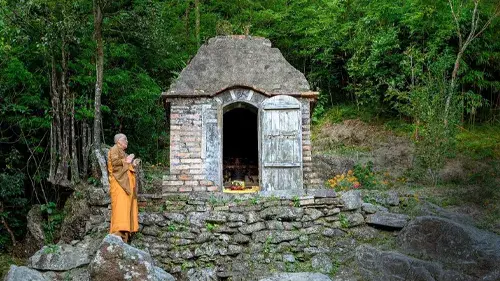
History Etched in Stone: The Legacy of Zen Master Phap Loa
The story of Ho Thien Pagoda is inseparable from the life and vision of Zen Master Phap Loa (1284–1330), the Second Patriarch of the Truc Lam Yen Tu Zen tradition. According to historical texts such as the "Tam To Thuc Luc" and the stele at Quynh Lam Pagoda, Phap Loa founded Ho Thien Hermitage (along with Bac Ma Hermitage) in the fourth year of the Khai Thai era (1327) under the reign of King Tran Minh Tong. This was not a typical place of worship for the lay public; rather, it was conceived as an advanced, ascetic training ground for monks who had already graduated with distinction from the great Buddhist center at Quynh Lam Pagoda. Here, surrounded by pristine forests and rocky peaks, these elite monastics engaged in intensive meditation before descending the mountain to become abbots and teachers across the country.
The pagoda’s significance endured for centuries. During the Later Le Restoration period (17th–18th centuries), Ho Thien underwent large-scale renovations funded by the Trinh Lords, involving laborers from five surrounding districts. In 2018, archaeologists unearthed the vast foundational footprint of this original complex, revealing a dense, carefully planned religious center that thrived on this remote peak. The site preserves a massive stone stele, the "Tru Phong Tu Bi Ky," erected in 1736 and standing over 2.7 meters tall, which records the restoration efforts and extols the serene beauty of the pagoda.
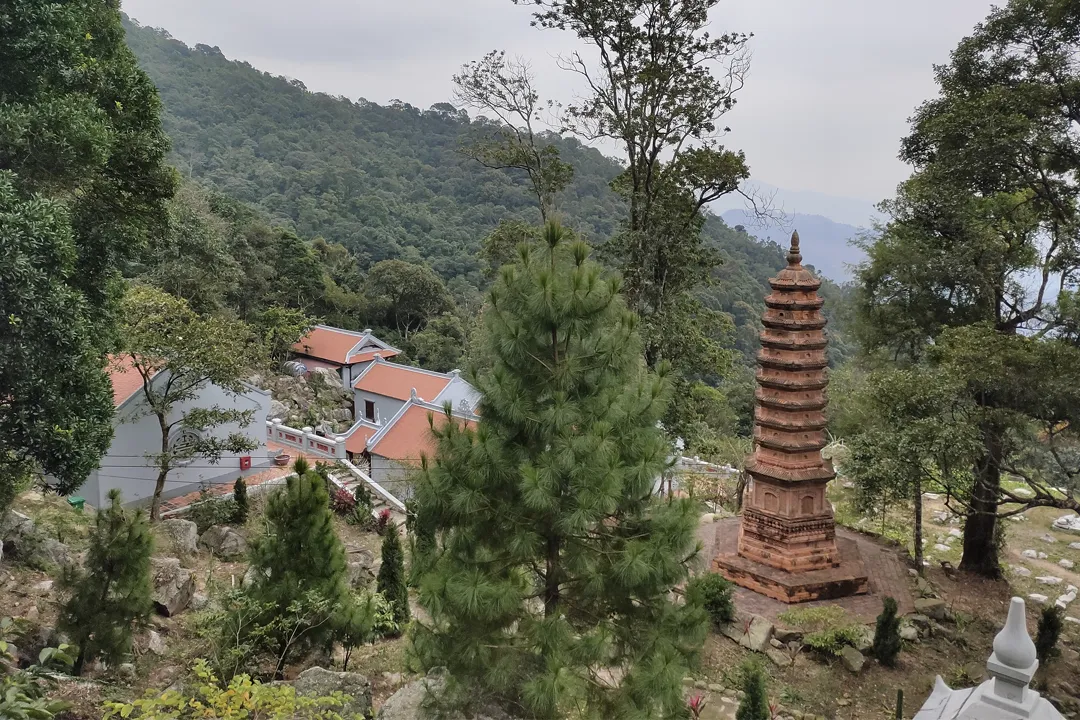
Architecture in the Clouds: The Pagoda’s Dual-Zone Layout
The architectural layout of Ho Thien is a masterful adaptation to its mountain environment. The pagoda is organized into two distinct yet connected zones. The primary zone, covering a generous 3,000 square meters, faces south in accordance with traditional Vietnamese religious principles and encompasses the Front Hall, the Incense Burning Hall, the Main Sanctuary, the Patriarch’s House, the Monks’ Quarters, and a secluded Hermitage Area. Archaeological findings, including stone pillar bases of astonishing size—the largest measuring up to 80 centimeters in diameter—indicate that the original Tran Dynasty structures were built on a monumental scale, using robust timber frames and traditional "yin-yang" roof tiles.
The second zone, located approximately 200 meters to the east, holds the Stele House that safeguards the pagoda’s ancient stone inscriptions. The complex’s harmonious integration into the landscape—embodying the feng shui ideal of the Azure Dragon on the left, the White Tiger on the right, a supporting pillow behind, and a screen of hills in front—is regarded as one of the finest surviving examples of medieval Vietnamese Buddhist environmental planning. Today, the pagoda complex has been meticulously reconstructed with a modern Tam Bao sanctuary and a guesthouse, while still preserving the precious archaeological vestiges that speak of its eight centuries of spiritual life.
The Tower Garden and the Seven-Tiered Stone Stupa
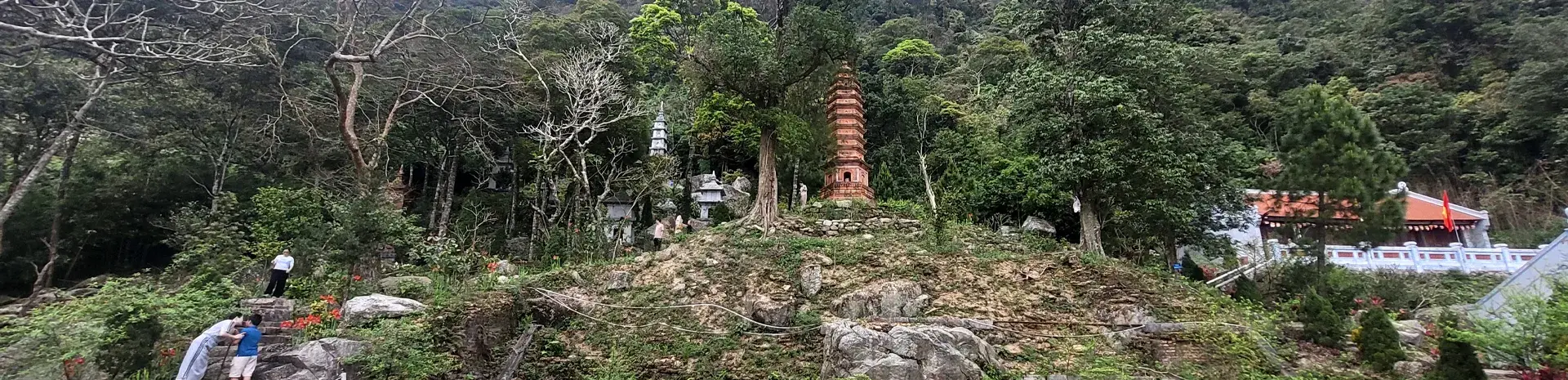
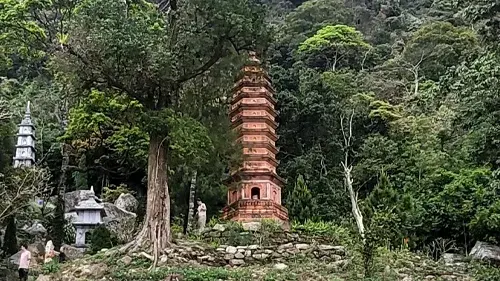
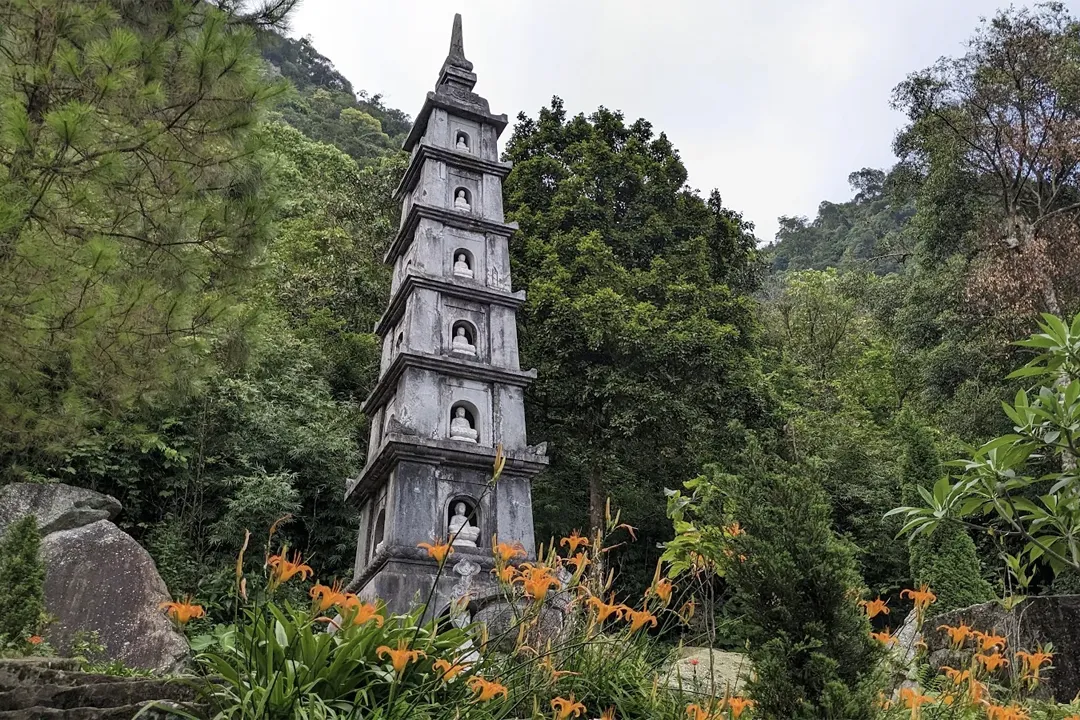
Perhaps the most visually arresting feature of Ho Thien is its tower garden. Nestled behind the main architectural axis, this sacred space is an indispensable element of Truc Lam landscapes. Here, visitors find one stupa dedicated to the Buddha and six stupas honoring the pagoda’s patriarchs. The Buddha stupa, originally constructed during the Tran Dynasty with five stone tiers, was enlarged in later periods to reach seven tiers. This elegant stone structure functions as a spiritual beacon on the mountainside. Alongside these reconstructed monuments stands one exceptional original—a brick patriarchal stupa that has survived from the Later Le Restoration period. With its warm, weathered red brickwork, it provides a direct and deeply tactile link to the 18th-century artisans who built it.
Spring at the Summit: A Sanctuary of Blossoms and Mist
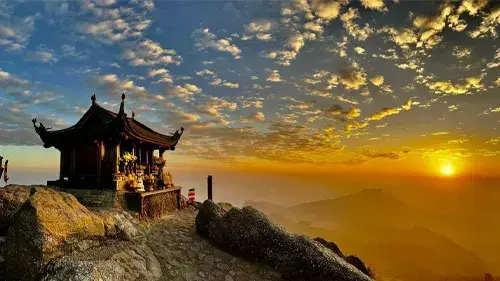
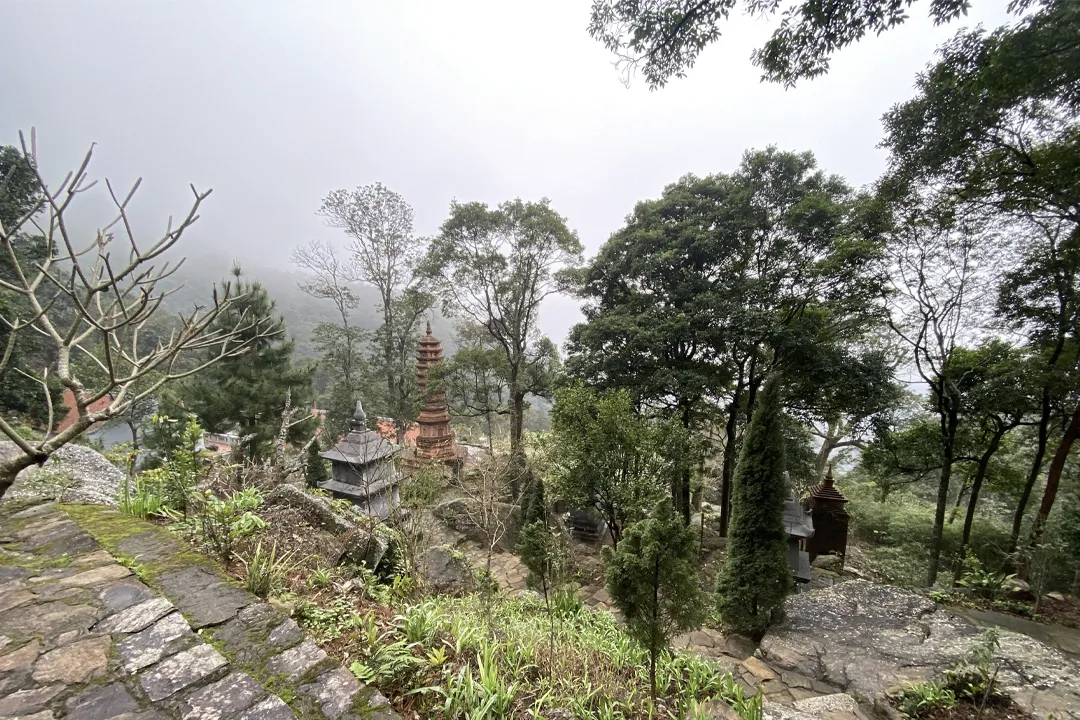
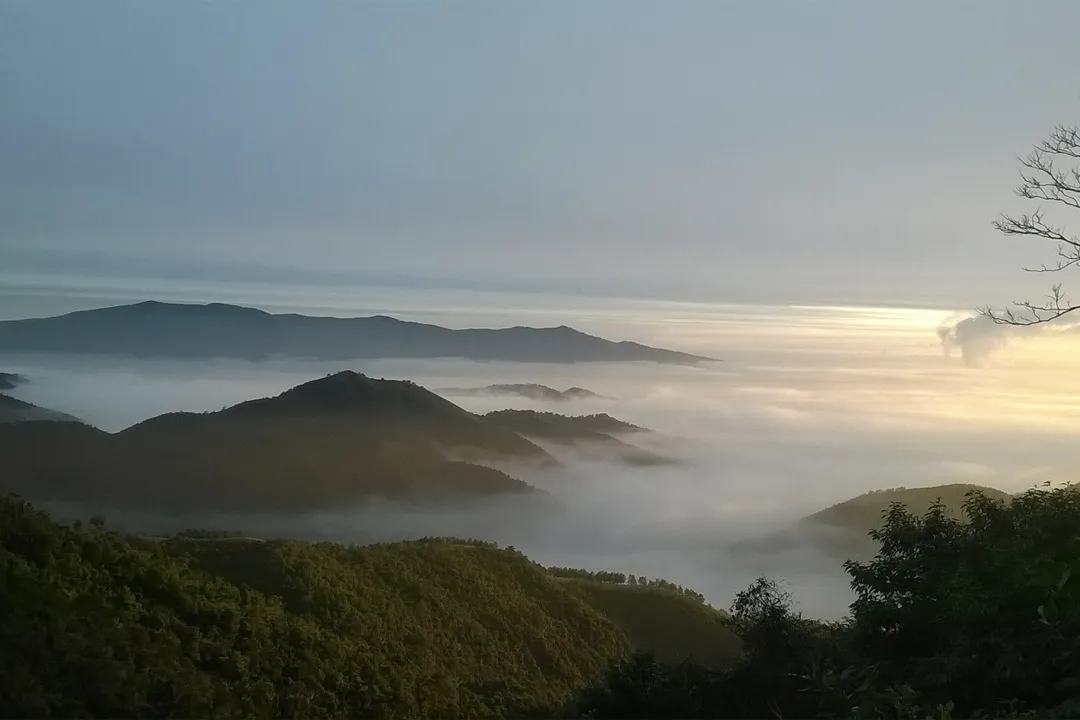
The atmosphere at Ho Thien transforms dramatically with the seasons, but it is at its most enchanting during the spring. From the first lunar month onward, as the lowland delta prepares for Tet, the mountain air remains crisp and cool, and a fine mist often cloaks the summit in the early morning hours. Wild peach blossoms and plum flowers begin to bloom along the trails, their delicate pink and white petals a gentle contrast against the dark, moss-covered stone of the ancient stupas. During the early spring months, the pagoda welcomes a steady stream of pilgrims who come not only to pray for blessings in the new year but also to breathe the pristine mountain air and witness the sunrise as it breaks over the layered limestone peaks of the Yen Tu range, transforming the sea of clouds below into a river of gold.
As the season progresses into the third lunar month, the landscape erupts in a more vivid shade of green, heralding the renewal of life. The surrounding forest becomes a symphony of birdsong—the calls of crested bulbuls echoing through the valleys and the flash of red from a silver pheasant along the hiking trails not an uncommon sight for the quiet observer. While the rainy season from May to September makes the ascent more challenging and shrouds the summit in unpredictable weather, the cooler autumn months from October to December return a crystalline clarity to the air, offering the year’s most spectacular panoramic views. For those seeking the most botanically beautiful and climatically pleasant experience, however, the February-April window remains the most rewarding time to ascend this sacred mountain.
Anchoring a UNESCO Dream: The Yen Tu Complex
Ho Thien Pagoda does not stand alone; it is an essential link in a chain of sacred sites that stretches across three provinces. It is one of the core components of the Yen Tu - Vinh Nghiem - Con Son Kiep Bac Complex, which is actively seeking UNESCO World Heritage status. Within the Dong Trieu region alone, the pagoda is part of a network of 14 Tran Dynasty sites. Efforts are underway to make the experience more accessible, with a cable car line connecting the Da Chong area to Ho Thien planned to link it with the Ngoa Van Pagoda further along the ridge. This connectivity will allow modern pilgrims to trace the entire spiritual geography of the Truc Lam founders, from the royal temples at the base of the mountains to the ascetic hermitages at their peaks, making Ho Thien not just a destination, but a vital chapter in a much larger sacred narrative.
The Ascent: Trekking Routes to the Pagoda
Reaching Ho Thien Pagoda is a rewarding experience in itself. From the designated parking area at the base of Phat Son Mountain, visitors embark on a trek of roughly 30 to 40 minutes along a well-marked forest path to reach the pagoda gate. The trail ascends steadily through a dense canopy of tropical hardwoods and pines, with the air growing noticeably fresher with every step away from the lowlands. For those who prefer a less strenuous approach, the planned cable car system will eventually offer a swift and scenic alternative, gliding above the treetops and delivering travelers to the pagoda in just a few minutes. Currently, the trek remains the primary way to arrive, and the effort is generously rewarded by the sense of tranquility and accomplishment that greets you at the summit.
Preservation and Renewal: A Modern Spiritual Tourism Destination
In recent years, Ho Thien Pagoda has benefited from a transformative state-led restoration project that concluded in 2023. With a total investment of 63.94 billion VND (approximately 2.6 million USD), a meticulously planned 18.1-hectare site was rehabilitated through socialized funding. The project successfully reconstructed the Tam Bao Hall (Main Sanctuary), the Patriarch’s House, the Monks’ Quarters, a Guest House, and auxiliary facilities, all while safeguarding the archaeological remains. Today, the pagoda functions as both a serene destination for spiritual tourism and an active monastery, attracting pilgrims, scholars, and culturally curious travelers from across Vietnam and beyond.
Pro-Traveler Experience Tips
A visit to Ho Thien Pagoda is a spiritual and physical journey that rewards careful preparation. Begin your day early, ideally arriving at the base of the mountain by 7:30 AM, to ascend in the cool morning air and experience the summit at its most serene. The 30-to-40-minute trek is moderately demanding; wear sturdy hiking shoes with good grip, as the path can be uneven and slippery, especially after rain. Modest clothing covering your shoulders and knees is essential, as this is an active Buddhist monastery, and you will be required to remove your shoes before entering the inner sanctums.
The pagoda is open daily from approximately 7:00 AM to 5:30 PM, and there is no entrance fee, though a voluntary donation of 20,000–50,000 VND (0.80–2.00 USD) is a respectful gesture. Bring drinking water and a light snack, as there are limited vendors on the mountain, though a small parking fee of about 10,000 VND (0.40 USD) for motorbikes is typical. Photography is encouraged, but always refrain from using flash near the ancient statues and stelae, and never touch the fragile stone surfaces. The summit can be significantly cooler than the lowlands; a light jacket is recommended, even in spring. Above all, leave space in your schedule simply to sit in silence—on the steps of the seven-tiered stupa or beneath the pines—for it is in these quiet moments that the true voice of Ho Thien is heard.