A Patriarch's Vision: The Founding of Thanh Mai
The story of Thanh Mai Pagoda is inseparable from the life and legacy of one of Vietnamese Buddhism's most dynamic leaders. Zen Master Phap Loa (1284–1330), born Dong Kien Cuong in what is now Hai Phong city (old Hai Duong Province), was just twenty years old when he encountered the Buddha-Emperor Tran Nhan Tong during a royal visit to his home village in 1304. Recognising the young man's extraordinary spiritual potential, the emperor — who had already abdicated the throne to establish the Truc Lam Zen school on Yen Tu Mountain — accepted him as a disciple, bestowing upon him the Dharma name Hi Lai. Phap Loa's rise was swift and merited: shortly before his own passing in 1308, Tran Nhan Tong formally invested him as the Second Patriarch of the Truc Lâm tradition, entrusting him with the immense responsibility of propagating the newly founded school throughout Đai Viet.
Phap Loa embraced this mission with tireless energy. He travelled widely, ordained thousands of monks and nuns, established monastic centres, and personally compiled numerous scriptures. Around 1329 — the exact date is recorded on stone stelae still preserved at the site — he founded Thanh Mai Pagoda on the slopes of what was then known as Phật Tích Mountain, expanding it into a large-scale architectural complex that cascaded from the summit down to the foothills. The pagoda became one of the great teaching monasteries of the Tran Dynasty, a crucial link in the sacred geography that stretched from the capital Thăng Long to the original hermitages at Yen Tu. When Phap Loa passed away at Quynh Lam Monastery on the third day of the third lunar month in 1330, his relics were enshrined in a stone stupa behind Thanh Mai Pagoda — the Vien Thong Bao Thap — where they remain a focus of veneration to this day. His successor, Zen Master Huyen Quang, became the Third Patriarch, and the Truc Lâm tradition he had done so much to build continued to flourish for centuries.
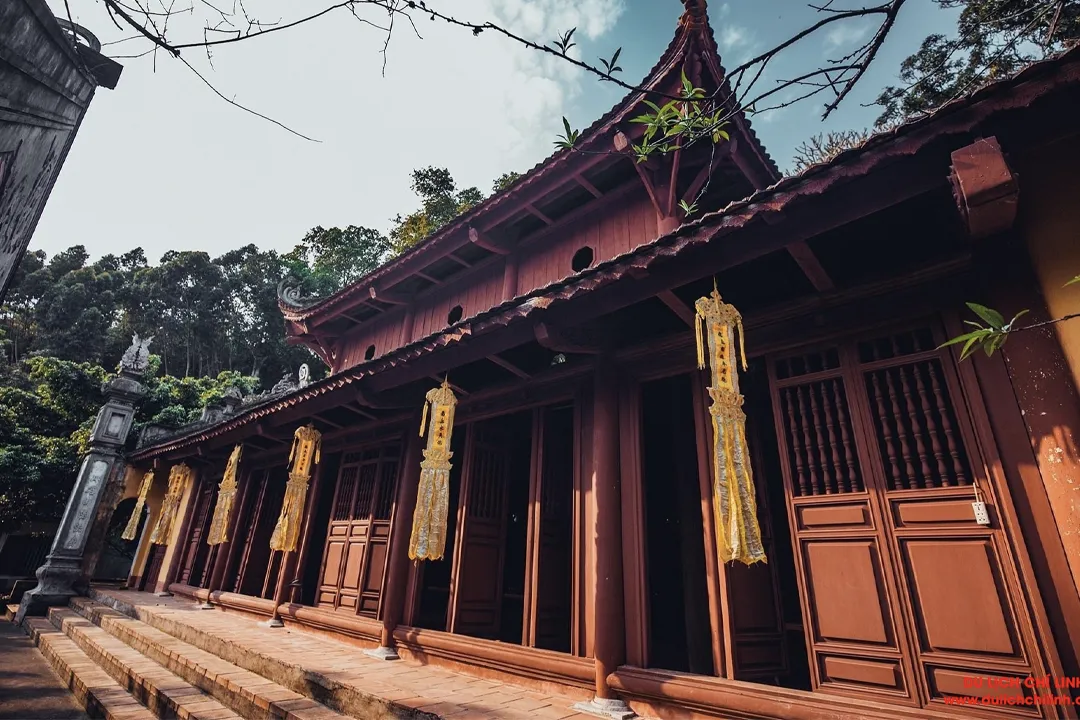
The Layout of a Medieval Centre of Learning
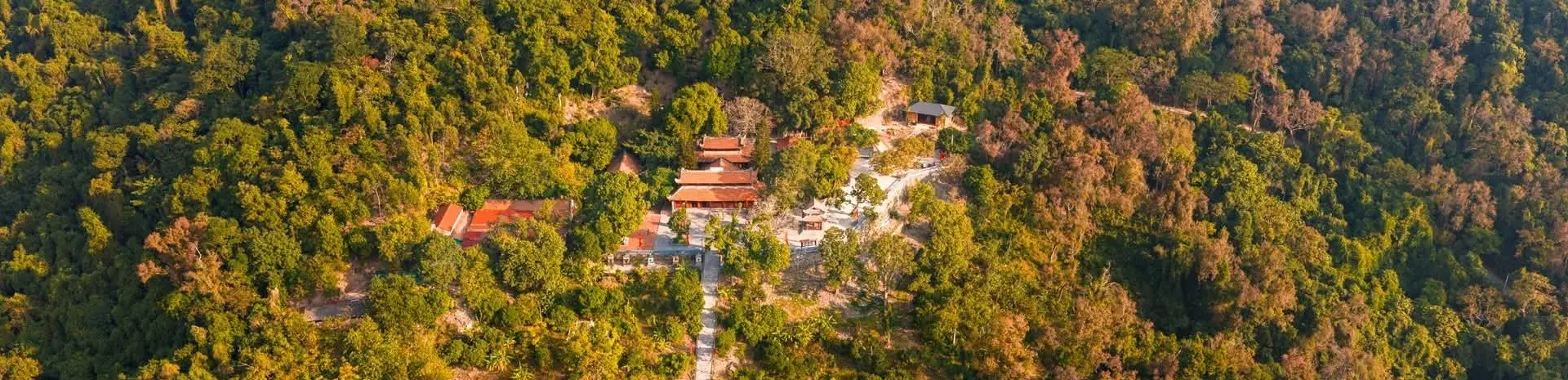
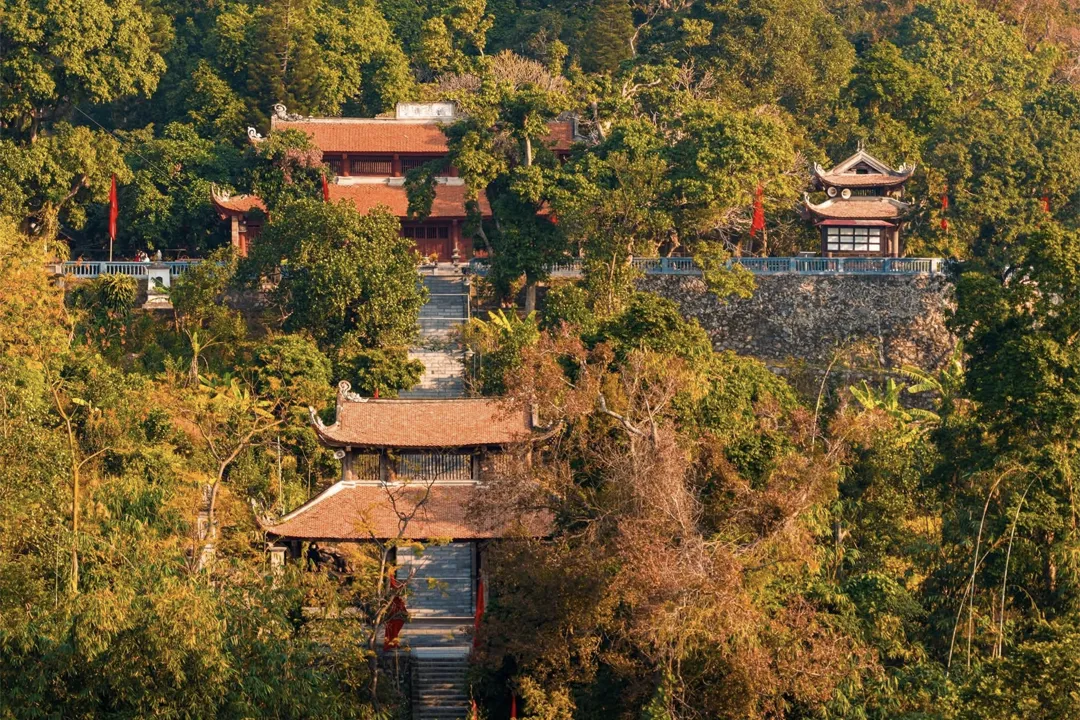
Approaching from the foothills, a winding road leads through peaceful hamlets before climbing into the forested slopes of Tam Ban Mountain, whose name — meaning "Three Levels" — refers to the mountain's position at the intersection of three provinces. The pagoda complex unfolds across approximately 16 hectares in a harmonious sequence of architectural spaces, much of it laid out along a vertical axis that follows the natural contours of the mountainside and faces south, in accordance with traditional Vietnamese religious principles and the feng shui ideal of the Azure Dragon on the left, the White Tiger on the right, a supporting pillow behind, and a screen of hills in front.
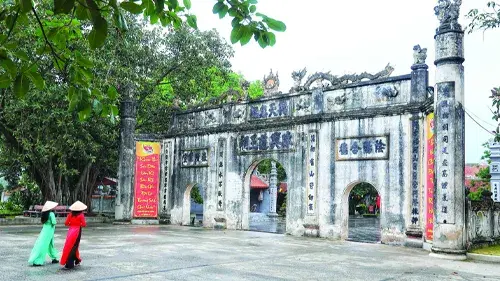
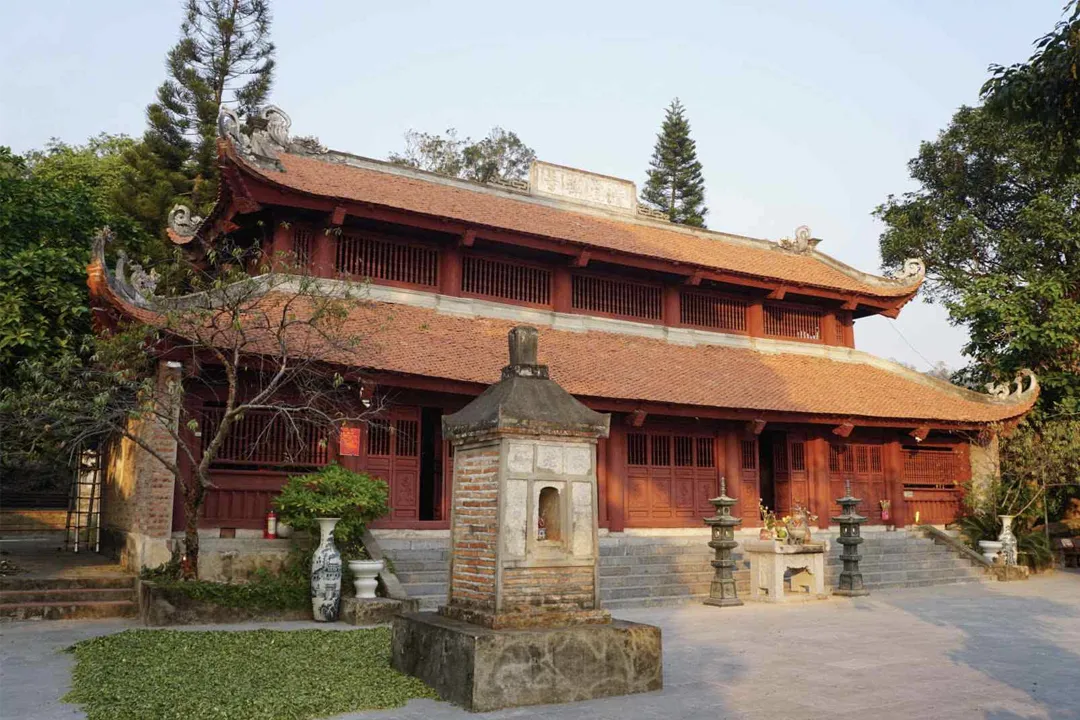
The journey into the sacred begins at the Tam Quan, a striking triple-arched entrance gate built in the "stacked pavilion" style with two storeys, three bays, and eight gracefully curling roofs. Constructed from ironwood and floored in red brick, this 60-square-metre structure is an architectural statement of deep elegance, its curved eaves and shaded passageways framing the forest beyond like a living painting. From the gate, visitors cross a broad garden courtyard to reach the stele pavilion, a wooden structure sheltering some of the pagoda's most precious documents. The main sanctuary follows a "Đinh" (T-shaped) layout characteristic of the Tran Dynasty: seven bays in the front hall flow into three bays in the rear sanctum, the whole supported by an intricate system of crossbeams, rafters, and brackets arranged in the "stacked beams of eight buckets" style that was the hallmark of medieval Vietnamese temple carpentry.
Behind the main hall stands the Ancestral House, a space dedicated to venerating the Three Patriarchs of Truc Lam: Tran Nhan Tong, Phap Loa, and Huyen Quang. Beyond this, the Vien Thong Bao Thap rises in solemn silhouette, containing the sacred relics of Phap Loa himself. Throughout the complex, subsidiary structures — the Mother Goddess hall, the monks' quarters, the guest house, the scripture repository, and the bell tower — complete a fully functioning monastic environment that, even in its partially restored state, vividly conveys the scale and sophistication of Trần-era Buddhist institutions.
Sacred Stones: The National Treasure Stele
Despite the ravages of nearly seven centuries — war, tropical storms, and long periods of abandonment that left the pagoda largely in ruins by the late 20th century — Thanh Mai has miraculously preserved seven original stone stelae from the Trần and Later Lê dynasties. Among these, one stands apart as a work of truly exceptional historical importance: the Thanh Mai Vien Thong Thap Bi. Carved and erected in the fifth year of the Dai Tri reign (1362), this stele records in meticulous detail the life and spiritual career of Phap Loa, the political and religious context of his era, and the activities of all three Truc Lam patriarchs. It is at once a biography, a dynastic chronicle, and a foundational document of Vietnamese Buddhism.
Recognising its irreplaceable value, the Government of Vietnam formally designated the Thanh Mai Vien Thong Thap Bi a National Treasure on 22 December 2016. Today, it stands protected within the stele pavilion, its weathered surface — densely inscribed with classical Chinese characters — offering scholars and pilgrims alike a direct, tangible link to the intellectual and devotional world of the 14th century. It is worth pausing here for a long, quiet moment; few other sites in northern Vietnam can offer such an immediate encounter with the written voice of the medieval past.
The Tower Garden: Eight Centuries in Stone
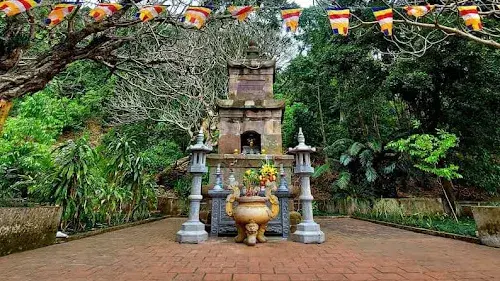
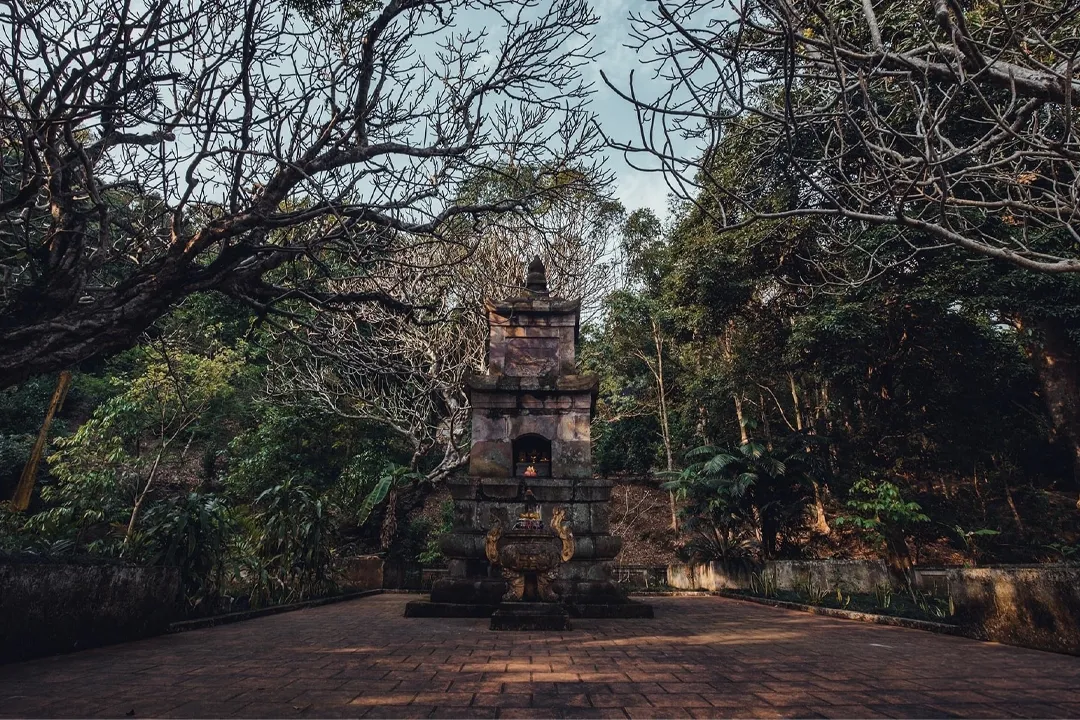
Scattered across the pagoda grounds, partially veiled by moss and the deep shade of the maple forest, are eight ancient funerary towers built between the 14th and 18th centuries — a "tower garden" typical of the most important Trúc Lâm monasteries. Each tower serves as the final resting place for an eminent monk or patriarch, constructed from grey-brown stone and capped with forms that range from simple square stupas to elaborate multi-tiered structures.
The most significant of these is the Vien Thong Tower itself, which contains the relics of Phap Loa. Standing approximately five metres high and built of finely dressed stone, it has been repaired twice in its long history — once in 1718 during the Later Lê period, and again in 2005 as part of a comprehensive restoration programme. To stand before this quiet monument, whose simple geometric elegance belies the profound devotion it represents, is to feel the continuity of Vietnamese Buddhism across the centuries, an unbroken thread of veneration that connects the medieval monks who first prayed here with the pilgrims who arrive today.
The Enchanted Forest: Maples and the Poetry of Autumn
For all the depth of its history, perhaps the most immediately captivating feature of Thanh Mai is its natural setting. The pagoda is enveloped by a dense forest of approximately 15 hectares dominated by ancient maple trees — local variants that grow to heights of tens of metres, their trunks so massive that two or three people linking hands can barely encircle them. This is not a planted garden but a genuine remnant of the primeval woodland that once covered these mountains, preserved here because the sanctity of the site protected it from logging and clearance.
Throughout the year, the maple canopy creates an atmosphere of perpetual green shade, the air cool and filled with the scent of damp earth and wild herbs. But it is during the late autumn and early winter months — roughly from November through January — that Thanh Mai reveals its most spectacular face. As temperatures drop, the maple leaves transform in a slow, breathtaking progression from deep green to brilliant yellow, vivid orange, and finally to a rich, saturated crimson that seems almost to glow against the grey winter sky. The forest floor becomes carpeted in colour, and the pagoda's ancient stone structures appear to float on a sea of fallen leaves. Local photographers, young travellers, and nature lovers make the pilgrimage during these months specifically to witness this fleeting display, which has earned the pagoda a reputation as one of northern Vietnam's most romantic and photogenic autumn destinations. Even outside the leaf-changing season, however, the forest offers a profound sense of peace; the only sounds are birdsong, the rustle of leaves in the mountain breeze, and the distant, resonant tone of the temple bell.
The Festival of the Second Patriarch
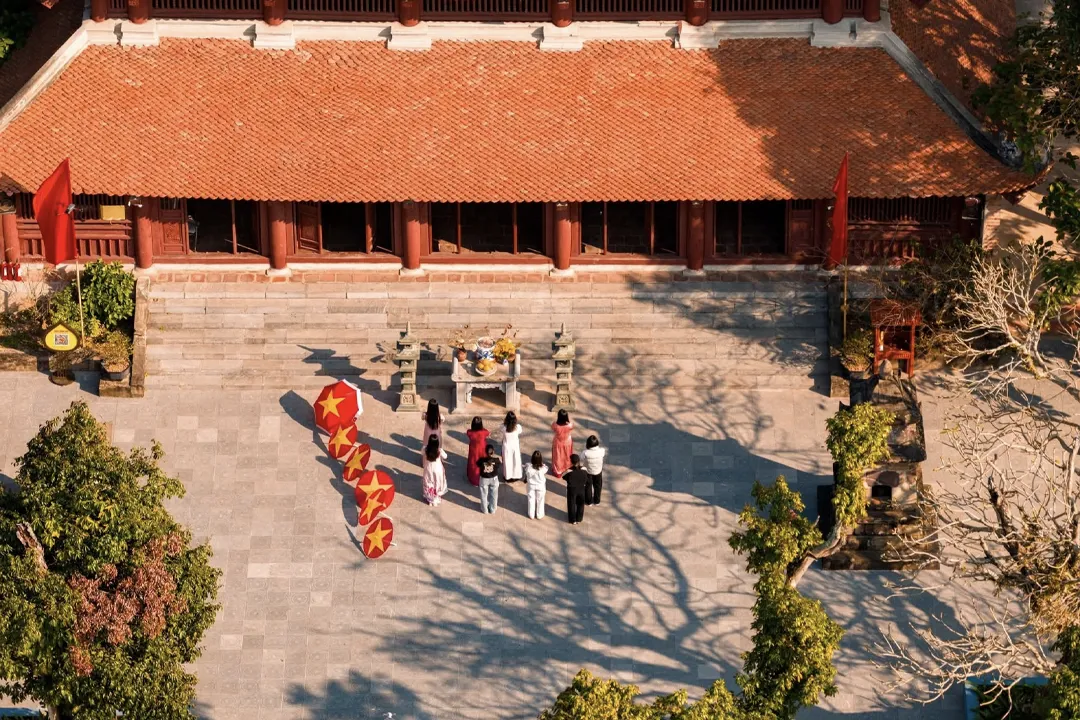
Each year, the quiet rhythms of Thanh Mai are transformed by the energy of its traditional festival, held from the first to the third day of the third lunar month (typically March or April). This is the occasion to commemorate the death anniversary of Zen Master Phap Loa, the pagoda's founding patron, and the ceremonies are among the most authentically observed in the Red River Delta.
The festival unfolds over three days in a seamless blend of solemn ritual and communal celebration. The opening day features a formal incense-offering ceremony, attended by government officials, monastic delegations, and thousands of pilgrims who arrive to pay homage to the Second Patriarch. Monks in saffron robes lead the chanting of sutras, while the rhythmic beat of the wooden fish drum reverberates through the mountain air. On the second day, the atmosphere shifts: the "Conquering Tam Ban Peak" mountain-climbing race sends competitors scrambling up the forested slopes, and an exhibition celebrating Thanh Mai's outstanding global heritage values — part of its recognition within the UNESCO-inscribed Yen Tu – Vinh Nghiem – Con Son, Kiep Bac complex since July 2025 — offers visitors a deeper understanding of the site's historical context. Folk games, calligraphy demonstrations, and stalls selling local specialties such as honey-roasted treats and traditional baked goods create a lively, interactive space that appeals especially to younger visitors. The festival closes on the third day with the most sacred ritual of all: the Mông Sơn Thí Thực ceremony, a Buddhist rite dedicated to feeding hungry spirits, followed by the final memorial service at the Vien Thong Tower. For travellers fortunate enough to time their visit to coincide with this festival, Thanh Mai offers an unforgettable window into the living, breathing faith of Vietnamese Buddhism.
Thanh Mai as a Point of Pilgrimage on the Truc Lam Sacred Arc
Though its remote location means it receives fewer visitors than some of its sister sites, Thanh Mai Pagoda holds a position of irreplaceable importance within the sacred landscape of the Truc Lam tradition. Together with Yen Tu, Ngoa Van, Quynh Lam, Con Son, Bao An, and Vinh Nghiem, it forms part of the chain of Trần Dynasty monastic centres — the so-called "Dong Trieu arc" — that became the cradle of Vietnamese Zen Buddhism. In July 2025, UNESCO inscribed the Yen Tu – Vinh Nghiem – Con Son, Kiep Bac complex, including Thanh Mai, as a World Cultural Heritage site, an international recognition of the exceptional universal value of this spiritual landscape. Thanh Mai, with its ancient towers, its forest of maples, and its profound association with the Second Patriarch, is an essential chapter in this story — and for the discerning traveller, one of its most deeply atmospheric destinations.
Pro-Traveler Experience Tips
A visit to Thanh Mai Pagoda rewards both spiritual openness and thoughtful preparation. The pagoda is open daily to visitors, and there is no entrance fee — it remains, above all, an active place of worship — although a voluntary donation of 20,000–50,000 VND (0.80–2.00 USD) is a graceful and deeply appreciated gesture that supports the ongoing work of preservation. Parking at the base of the mountain is available for a small fee of around 10,000 VND (0.40 USD) for motorbikes and 30,000 VND (1.20 USD) for cars.
The journey to the pagoda from the parking area involves a walk of approximately 1.5 to 2 kilometres along a winding forest path that climbs gradually to an altitude of around 200 metres. The trail is well-established but can be uneven underfoot; wear sturdy, comfortable walking shoes with good grip, especially if you are visiting after rain, when the path may be muddy and slippery. Dress modestly, covering shoulders and knees, and carry a light jacket even in warmer months — the forest canopy holds cool, damp air that can be surprisingly chilly. Remove your shoes before entering the main sanctuary and the Ancestral House, and always speak in quiet, reverent tones within the temple buildings.
For photographers, the golden hours of early morning and late afternoon offer the most beautiful light, slanting through the maple leaves and illuminating the moss-covered stone of the ancient towers. Avoid using flash near the National Treasure stele and the altar statues, as intense light can damage their aged surfaces. A wide-angle lens is ideal for capturing the sweep of the forest, while a telephoto lens will help you frame details of the high roof carvings. If you are visiting specifically to see the autumn maple display, the most reliable window is from mid-November through late December, though the exact timing varies slightly from year to year depending on the weather. Weekdays are invariably quieter than weekends, and an early-morning arrival — by 8:00 AM — virtually guarantees solitude.
The annual festival on the first to third days of the third lunar month (typically April) is the most culturally vibrant period, but it draws large crowds; for a contemplative visit, choose a quiet weekday in spring or autumn instead. Carry drinking water and a light snack, as there are limited vendors along the trail, though local families near the pagoda gate sometimes sell seasonal fruit and simple vegetarian food. Combining Thanh Mai with nearby Con Son, Kiep Bac and Vinh Nghiem Pagoda as part of a two-to-three-day private car tour is strongly recommended, creating a pilgrimage circuit that traces the full sacred geography of the Truc Lam founders and offers one of the most spiritually enriching travel experiences in northern Vietnam.